
Summary
In this interview, Justin Huhn, founder of Uranium Insider, explains why the sell-off across uranium and nuclear equities reflects broad risk-off positioning and cracks in the AI data center narrative rather than any deterioration in the physical market, where the term price continues to grind higher against a structural supply deficit. He walks through the mechanics of the current contango market, the development timeline and contracting posture at NexGen's Rook One, hyperscaler interest in mine-level project finance, and expanding conversion and enrichment capacity.
Transcript
Key Takeaways:
- Contango Market Structure: Huhn notes spot trading around $84 against a term price of $94, which he describes as a normal bull-market forward curve. He says base-escalated contracts are starting in the mid-$90s, fixed-price contracts are being signed in triple digits, and market-referenced deals with Cameco, Kazatomprom, or Orano carry ceilings of $130 to $160 with floors in the $70s and $80s.
- Why Utilities Avoid Spot: He argues utilities largely stay out of the spot market in volume because their own buying would move the price against deliveries they are already receiving under market-referenced contracts signed in prior years. Securing millions of pounds annually, in his view, requires going to the term market and paying up.
- Rook One Development Risk: Huhn says NexGen has begun construction on Rook One with all permits and First Nations mutual benefit agreements in place, on a 48 to 54 month timeline. He points to roughly 150 metres of overburden above the hard-rock deposit as the main uncertainty in the mine plan and expects the market to know within 12 to 18 months whether the project stays on schedule, while suggesting the $2.2 billion capex estimate made almost two years ago will likely breach $3 billion.
- The 29 Million Pound Assumption: He argues utilities and sector modellers are still carrying 29 million pounds a year from Rook One into their 2031 supply forecasts, and that this will not happen. Huhn points out the company is now communicating that it needs only 5 million pounds a year for the mine to be profitable and will produce to what contracts dictate rather than to nameplate capacity.
- Hyperscaler Project Finance: Huhn says hyperscalers are in direct conversations with NexGen about project financing, which he describes as confirmed and something the industry never expected. He draws a parallel to Amazon's direct investment in an Arizona copper producer and argues any offtake agreement between a big tech company and a uranium developer would be a significant catalyst for the sector.
- Supply Development Outside the West: He notes most development progress is occurring in the East, citing Chinese-developed Husab in Namibia, a Russian ISR project called Wings that has struggled amid drought conditions, Uzbek production growth with French and Japanese involvement, and a newly reported French ISR development in Mongolia after nearly 30 years of exploration, which he sizes at a few million pounds a year potentially rising to 5 or 6 million.
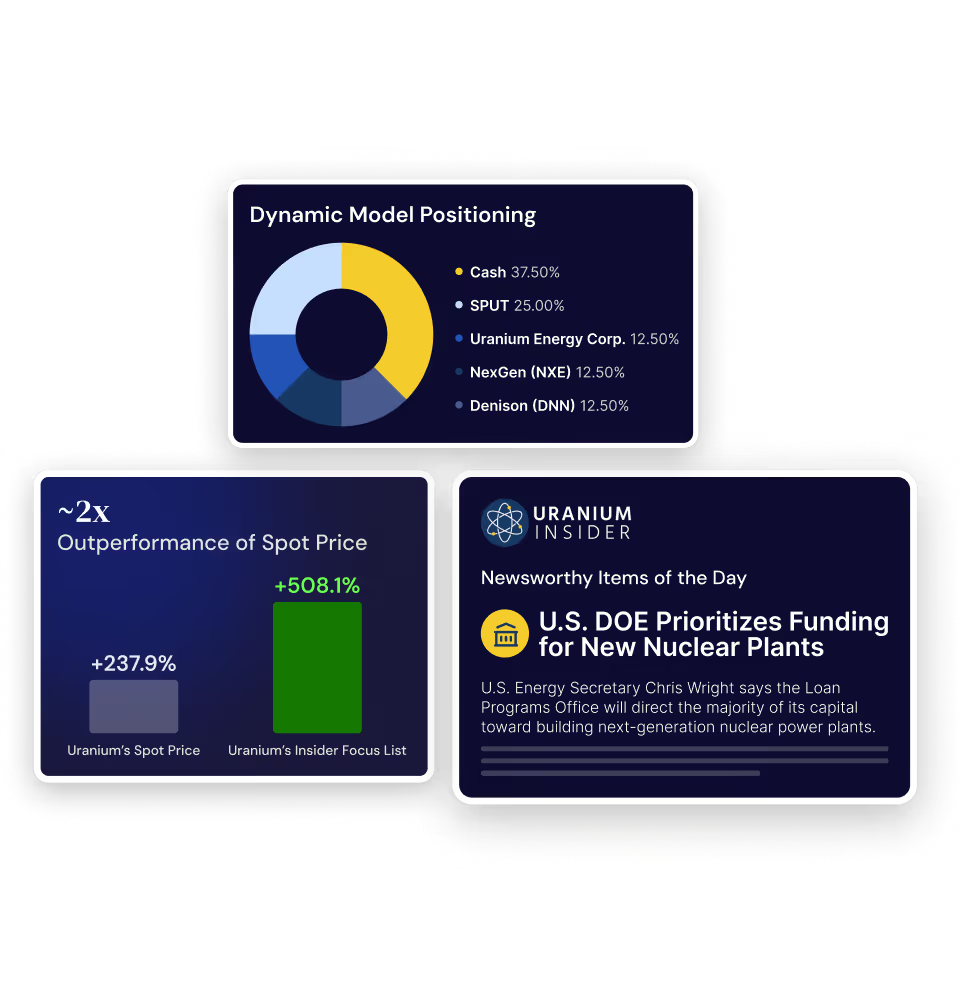
- Positioning Into the Correction: Huhn says Uranium Insider built a cash position through January to April and is close to deploying it, with the sector at an RSI of 30 to 35 and a meaningful bottom expected within the next month to six weeks. He attributes the nuclear equity sell-off to correlation with the AI trade rather than sector fundamentals, while separating what he considers quality large caps from names like Oklo and Centrus, whose prior moves he attributes to retail momentum.


.avif)
