
Summary
In this interview, Justin Huhn, founder of Uranium Insider, explains why the next phase of uranium supply growth cannot be met by restarting idled mines and must instead come from greenfield projects that have never been built. He walks through the record long-term contract price, the shift toward market-referenced contracts with high ceilings, early hyperscaler engagement with the fuel cycle, and the case for holding physical uranium exposure through the current equity drawdown.
Transcript
Key Takeaways:
- Record Term Price: Huhn puts mid-market spot at roughly $85.50 against a long-term price of $97 as reported by TradeTech and $94 as reported by UXC, a blended $95.50 that he identifies as an all-time high for the term market. He argues the term price, rather than the discount on physical vehicles, is the better predictor of where spot moves next.
- Contract Structure Shift: Contracts signed by Cameco, Orano, and Kazatomprom are now mostly or entirely referenced to the market at time of delivery, versus roughly 70–80% fixed price in 2018 and a 50/50 blend in 2021–2022. Huhn says producers are seeking floors in the $70s and $80s and ceilings of $150–$160, with some 2030s deliveries pushed north of $160, while fixed-price contracts are currently being written above $100.
- Brownfield Exhaustion: Huhn attributes the roughly 30% growth in mined supply since 2020 almost entirely to restarts — McArthur River, Langer Heinrich, and smaller operations from Boss Energy, enCore, Energy Fuels, and UEC — plus incremental ISR volumes from Kazakhstan and Uzbekistan. What remains is limited: a Rabbit Lake restart, a McArthur River expansion to a 24–25M lb nameplate, and a few million pounds from Cameco's US ISR assets.
- Greenfield Requirement: He argues the balance of future supply must come from mines that have not been constructed, a dynamic he says has not existed since the first build-out of civilian nuclear in the 1950s and 1960s and one that distinguishes this cycle from the previous run to $134. He cites the World Nuclear Association reference case of 390M lbs of demand by 2040 against current production, and points to Denison's Phoenix ISR project and Global Atomic's Dasa mine in Niger as among the few greenfields actually under construction.
- Hyperscaler Off-take: Huhn describes direct hyperscaler engagement with the fuel cycle as already underway, citing Travis McPherson of NexGen Energy confirming at the World Nuclear Fuel Conference that hyperscalers have approached the company about project finance for Rook I in exchange for off-take, following comments by CEO Leigh Curyer in January. He also references similar conversations reported by Centrus and by GE Vernova around the BWRX-300 build at Darlington, and calls an inked hyperscaler off-take the most significant right-tail catalyst currently visible.
- Demand De-risking: Citing Jonathan Hinze of UxC, Huhn notes roughly 400 GW of operating capacity moving to approximately 500 GW within five years, growth already locked in by reactors under construction — around 70 globally, with 38 in China. He adds that a 50% cut to AI capex projections would not alter the core supply-demand framework, since modeled growth derives from reactors under construction rather than data center demand.
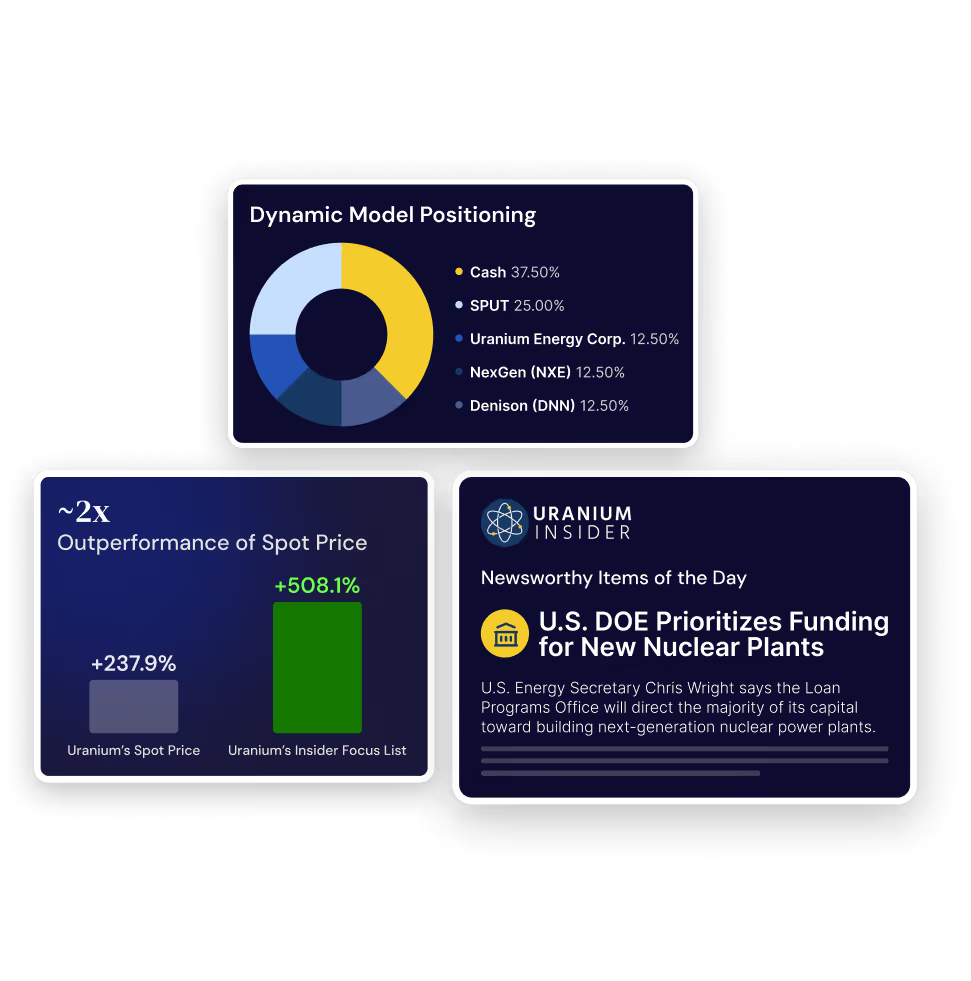
- Physical Over Equities: Huhn holds the Sprott Physical Uranium Trust in size and describes it as the best risk-reward proposition in the sector at a roughly 10% discount to NAV, down from 12.5% two days prior. He frames downside as low single digits absent a liquidity event forcing hedge fund selling, against upside he estimates at 100% or more, and notes that double-digit discounts to NAV have historically marked sentiment bottoms.


.avif)
