
Summary
In this interview, Justin Huhn, founder of Uranium Insider, explains why he believes the uranium market remains in the middle of a long cycle, with mine supply running roughly 30 million pounds below annual reactor demand and no realistic path to balance within the next five to seven years. He walks through the multi-decade development timelines that keep supply from responding to price, the reactor build-out and life-extension pipeline behind his demand model, the right-tail demand he does not model at all, and how he weighs the physical commodity against mining and nuclear equities.
Transcript
Key Takeaways:
- Supply Shortfall: Huhn estimates roughly 200 million pounds of reactor demand last year against about 170 million pounds mined, a shortfall of about 30 million pounds that has persisted for multiple years. He notes secondary supply has fallen from nearly 30 million pounds per year five or six years ago to under 10 million today, with enrichment underfeeding contributing an estimated 8 to 10 million pounds annually.
- Price and Utility Tolerance: He cites a long-term price of $90 per pound and a spot price near $85, and argues marginal projects need roughly $100 to $110 per pound to be profitable. Because uranium is only about 5 to 6% of a US reactor's operating cost — and the full fuel cycle roughly 15% — he contends operators can absorb multiples of the current price rather than shut down a strategic asset.
- Development Timelines: Huhn points to NexGen Energy's Arrow deposit at the Rook I project in the southwestern Athabasca Basin, which he says took roughly 10 years to move from discovery to construction permit. With a company-guided 54-month build, he places first production somewhere around 2031 to 2033 and describes the industry as heavily reliant on this single project as a gap filler.
- Demand Model: He models nuclear capacity growing about 4% compound annually, roughly 50% higher by 2035, based only on operating reactors, likely life extensions, and units already under construction — including 38 in China, which he says accounts for about half the global total. Speculative SMR build-out and hyperscaler-funded capacity are excluded from that figure entirely.
- US Policy Shift: Huhn describes the Nuclear Regulatory Commission's reform as a sea change after decades without a newly permitted reactor design, with TerraPower's Natrium project in Wyoming the only reactor currently under construction in the country. He references an executive order targeting 10 large reactors under construction by 2030 and a Japanese-backed fund of more than $300 billion, of which he says $80 billion is earmarked for those reactors.
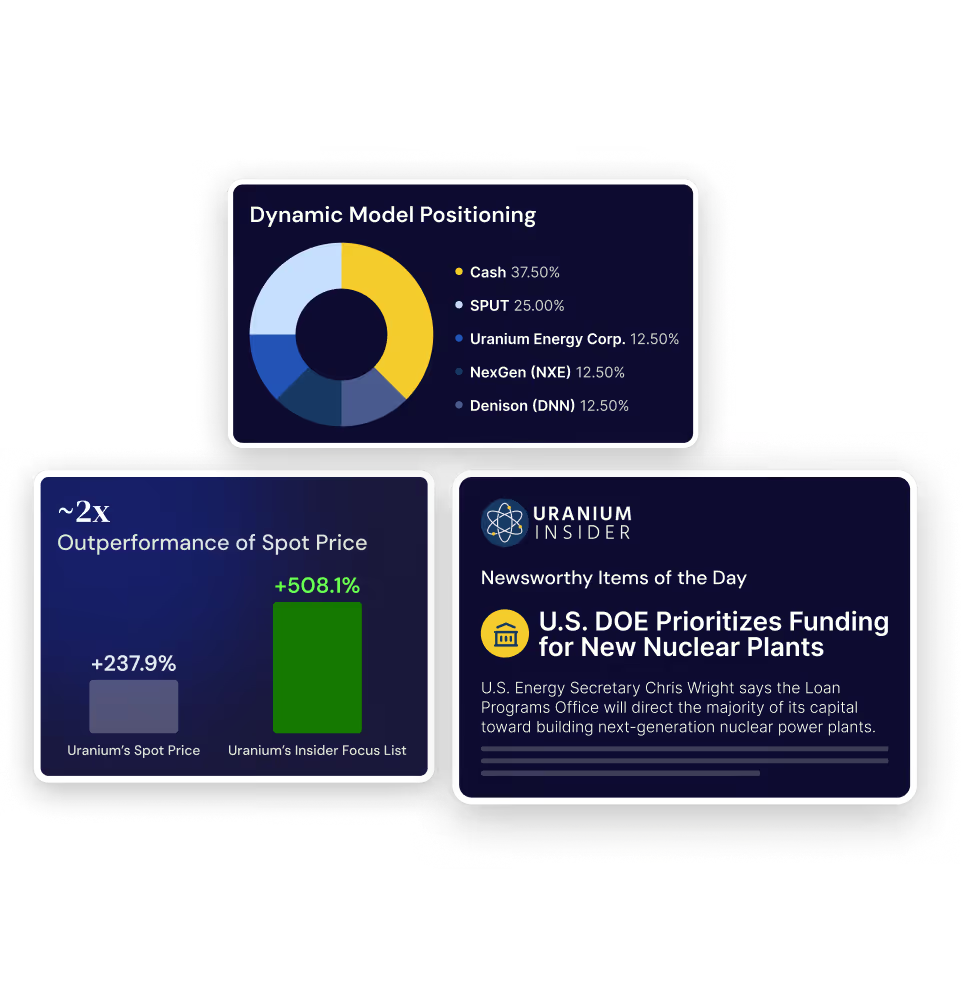
- Financial and Sovereign Demand: He notes the Sprott Physical Uranium Trust bought almost 9 million pounds in 2025 and has already purchased over 5 million pounds this year, taking in more than $400 million of capital in January alone, while Yellow Cake bought a little over a million pounds. He treats sovereign stockpiling and utility inventory restocking — US utilities typically hold about two years of inventory, the EU about three — as unmodeled right-tail demand.
- Investment Approach: Huhn argues the physical commodity offers the better risk-adjusted exposure since it carries no single-miner risk, while acknowledging that explorers and developers offer torque and that most juniors will never produce. He expects more nuclear and nuclear-adjacent companies to become investable over the next five years, citing Holtec — which is restarting Palisades — as going public in the coming months.


.avif)
