
Summary
In this interview, Justin Huhn, founder of Uranium Insider, explains why uranium itself — rather than conversion or enrichment — is becoming the binding constraint in the nuclear fuel cycle, with primary reactor demand now largely de-risked and supply unable to respond on the timelines utilities are contracting for. He walks through recent term contracting volumes and pricing, the coverage gap facing US utilities into the 2030s, the several categories of secondary demand that most models exclude, and his positioning across producers, developers, explorers, and sector ETFs during a quiet market.
Transcript
Key Takeaways:
- Uranium as the Emerging Bottleneck: Huhn recounts comments from UxC president Jonathan Hinze at the World Nuclear Fuel Markets Conference in Scottsdale, where Hinze projected global nuclear capacity growing from 400 gigawatts to 500 gigawatts — roughly 25% — within five or six years based only on operating reactors, confirmed life extensions, and units under construction. Asked which part of the supply chain concerned him most, Hinze named uranium, arguing it had been overlooked while attention went to conversion and enrichment following the Russia-Ukraine disruption.
- Contracting Volumes and Term Price: Huhn cites roughly 70 million pounds added to the long-term contract market in Q4 of last year, 32 million pounds year-to-date, and a separate India–Cameco–Kazatomprom agreement of approximately 45 million pounds that he says is not captured in the reported figure — around 150 million pounds contracted over roughly ten months. He notes the long-term price at $94 per pound, up $14 over the past year, while describing the volume as still short of replacement rate.
- Utility Coverage Gap: Because ex-Russian fuel cycle logistics take a minimum of two years and often two and a half or more, Huhn argues that demand dated 2032 and 2033 is being transacted now. He estimates 70 to 80% of US utilities are uncovered around 2032, with average coverage of roughly two years, and describes typical inventory as scattered across the fuel cycle rather than held as uranium.
- Secondary Demand Layers: Huhn identifies five categories he says most models treat conservatively or exclude: financial buyers, including 6.5 million pounds purchased year-to-date by the Sprott Physical Uranium Trust; sovereign stockpiling by China and potentially India, the EU, and the US; hyperscaler-driven SMR fuel buying, which his models do not show until around 2031 despite early evidence of buyers entering as construction begins; US military demand, which he says credible sources indicate will materialize this cycle; and utility inventory restocking above burn rate. He notes that modeled 2026 demand of 204 million pounds reflects only burn rate and a tails assay assumption.
- Supply Response Limits: Even assuming Arrow reaches its feasibility study nameplate of 29 million pounds by 2032, Kazatomprom produces 82 million pounds at 100% of subsoil use agreements, and projects including Phoenix and the ISR development in Mongolia come online, Huhn's models show the market balancing for a single year before the deficit widens sharply. He flags that NexGen Energy only needs roughly 5 million pounds annually to cover capital repayment, leaving a wide gap between that floor and nameplate, and points to Kazakh decline rates in the 2030s alongside Cigar Lake ending in 2035 or 2036. He says he does not know where supply for 2033 and beyond comes from without new development in Australia, Namibia, the US, and Saskatchewan.
- Policy and Near-Term Catalysts: Huhn references a same-day announcement of $17.5 billion in low-interest Department of Energy loans earmarked for long-lead items for AP1000 construction, noting the funds cannot be applied to uprates or SMRs. He expects spot to stay quiet through the summer months as fuel buyers step back, with a bottom in roughly four to six weeks and activity resuming ahead of the WNA conference in September, while describing the term market as more active than is typical for this time of year.
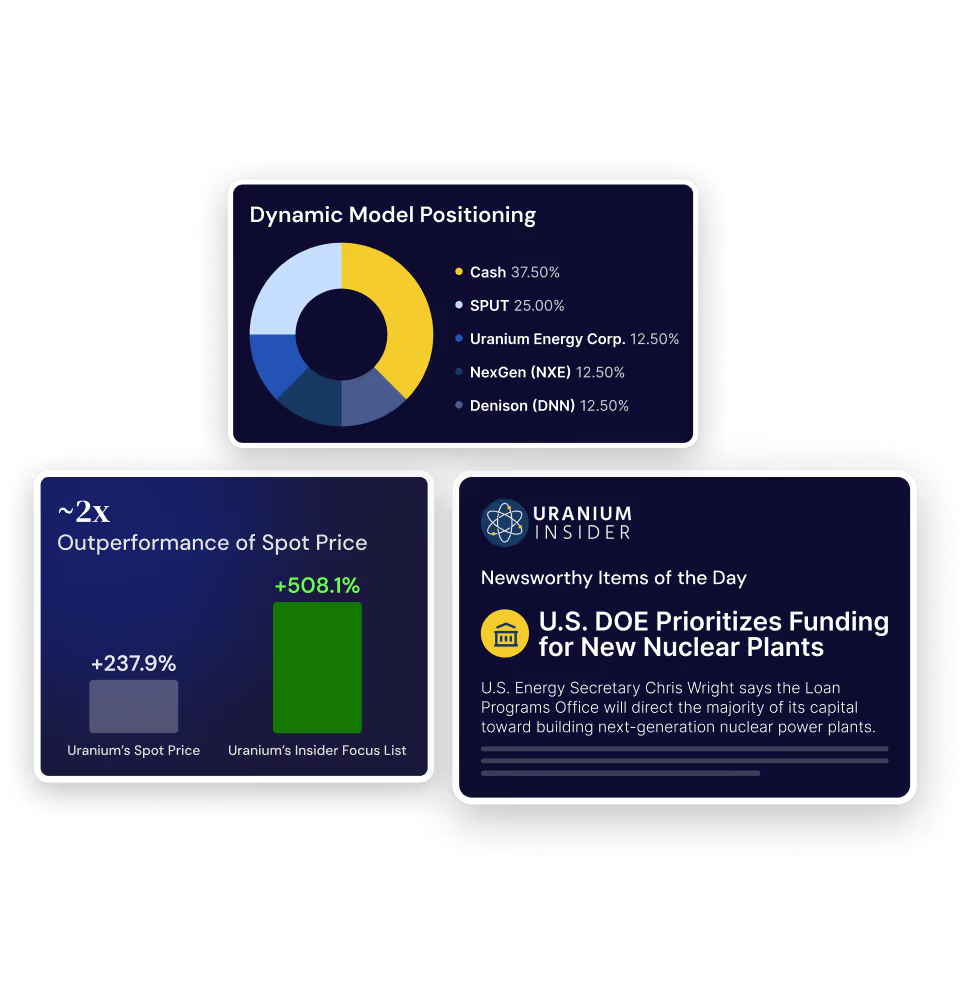
- Equity Positioning: Huhn says explorers and developers offer the best value propositions at present and that large-cap outperformance has been driven more by liquidity and AI-basket inclusion than by producer status. He views NexGen Energy as the clearest opportunity, arguing institutional selling tied to a buyout that did not materialize and to the Lassonde curve has created an entry point, and that once producing the company would hold more market-moving leverage than Cameco. Asked to choose a single ETF, he speculates on URNJ for its torque in a trough while noting it has not outperformed recently, and adds that NUKZ-style nuclear exposure is worth holding.


.avif)
