
Summary
In this interview, Justin Huhn, founder of Uranium Insider, explains why the industry has largely exhausted its restartable brownfield capacity and must now rely on greenfield development that current prices do not incentivize. He points to contract ceilings being signed well above the market, restarted operations running negative cash flows, forecasts of a 500-gigawatt global reactor fleet within five to six years, and the categories of demand — financialization, military, restocking, sovereign stockpiling — that sit outside standard models.
Transcript
Key Takeaways:
- Peak Brownfield: Huhn argues the sector has essentially reached the limit of what can be restarted, with roughly half of that low-hanging production already recovered. He notes there is still no signal from Cameco on restarting Rabbit Lake or its Nebraska and Wyoming ISR assets, leaving few meaningful brownfield candidates outside small US projects he characterizes as peanuts in volume terms.
- Greenfield Requirement: With brownfield capacity exhausted, Huhn says the deficit must be filled by projects that have never been built, a situation he describes as unprecedented outside the industry's founding decades. He cites Bannerman's Etango, Deep Yellow's Tumas, and a Cameco expansion of McArthur River toward 24–25 million pounds as examples of what needs to advance.
- Negative Cash Flows at Current Prices: At roughly $85 spot and $94 term, Huhn says almost none of the restarted brownfield operations are making money. He argues prices must move higher to compensate for capital and development risk, particularly with equity markets in a risk-off phase that makes financing difficult.
- Contract Ceilings as a Price Signal: Huhn points to market-referenced contracts being signed with ceilings around $150–$160 for deliveries three to six years out, roughly 60% above the current spot price and carrying CPI or GDP escalators. In his framing, those terms indicate where counterparties expect the price to go and imply wide margins for incumbent producers.
- Demand Modeling and the UxC View: Huhn recounts UxC president Jonathan Hinze telling the World Nuclear Fuel Markets Conference that global capacity moves from roughly 400 gigawatts today to 500 within five or six years on the operating fleet, life extensions, and reactors already under construction — and that uranium is the fuel-cycle element he is most concerned about. Huhn treats this as significant given UxC's visibility into inventories and uncovered demand.
- Right-Tail Demand: Beyond reactor burn, Huhn identifies four unmodeled demand categories: financialization by funds and traders, military procurement, utility inventory restocking, and sovereign stockpiling by countries including India, the US, and the EU. He notes Uranium Insider modeled 10 million pounds of secondary demand last year against actual volumes closer to 15 million or higher, and that such gaps materially skew annual balance estimates.
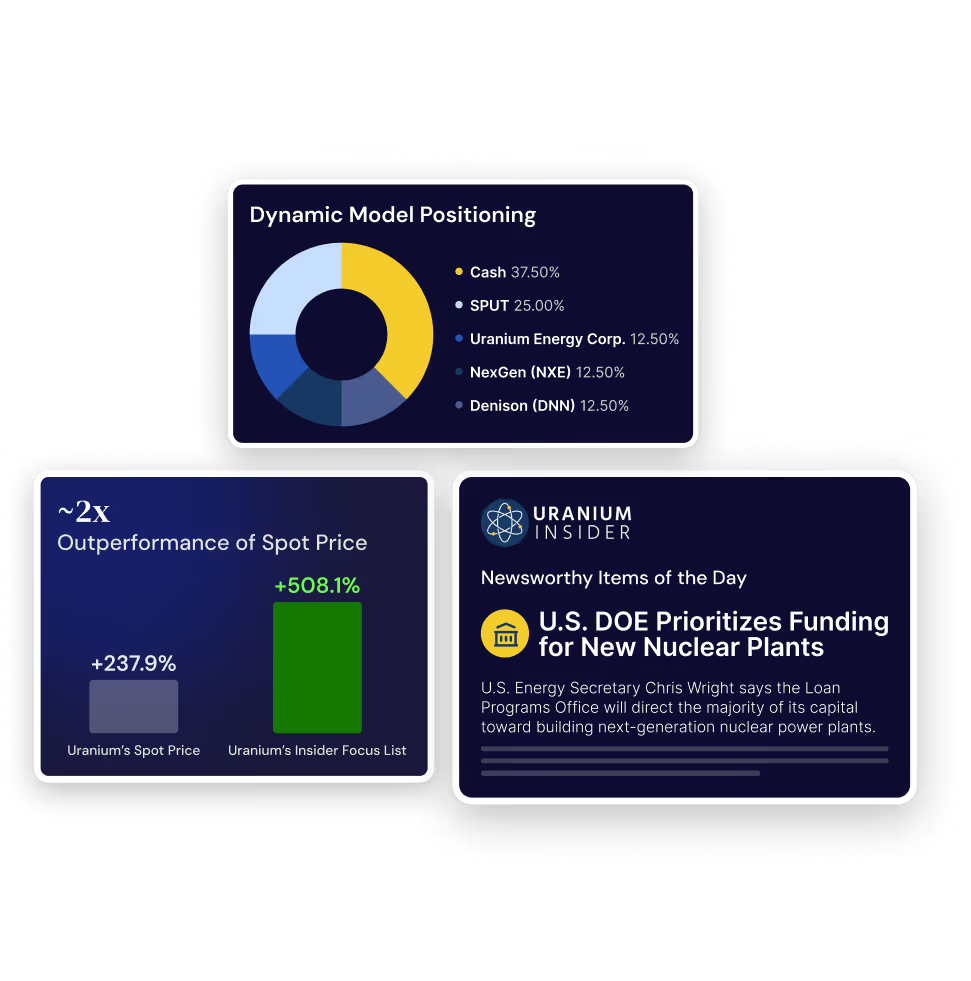
- Liquidity Concentration in Equities: Huhn says institutional buyers can access only about five sufficiently liquid names — Cameco, NexGen Energy, Denison, the Sprott Physical Uranium Trust and ETFs, and possibly Paladin — which is why liquidity and sentiment have moved the sector more than company-specific results. He argues the market has not rewarded companies for actually building assets, and that for most investors trading the large caps and ETFs through the cycle has been more productive than stock picking among the explorers.


.avif)
