Summary
In this interview with Charlotte McLeod of Investing News, Justin Huhn, founder of Uranium Insider, explains why he believes uranium equities are at or near a sentiment-driven bottom while the physical market remains firm. He also covers the split between sovereign and Western utility contracting, the Kazatomprom shareholder vote on a Russian contract, Russia’s own uranium buying, and how Uranium Insider has positioned its trading portfolio.
Transcript
Key Takeaways:
- Term Market Volumes: UxC reports 77.7 million pounds procured in the long-term market this year. Huhn believes voluntary reporting is declining and estimates actual volume at 90 to 100 million pounds, against roughly 200 million pounds of reactor demand.
- Sovereign vs. Western Buyers: Huhn says China, India and Russia are signing very large contracts with a security-of-supply approach, including an India–Cameco deal he estimates at 20 to 25 million pounds. Western utilities, facing Cameco floors of $80 per pound, are instead topping up in the spot market and signing small carry trade contracts of one or two million pounds.
- Spot Market Firmness: About 2.3 million pounds traded in the past four weeks, roughly 50% of typical volume, with the price flat for two months and buyers stepping in on 50-cent dips. Huhn notes spot is $19 higher and term $12 higher than a year ago, and he would not be surprised to see mid to high 90s, possibly higher, in spot by year-end.
- Producer Incentives: Paladin fell almost 20% after producing about a million pounds in the quarter, down from 1.2 million, with costs in the low 60s against a realized price in the 70s. Huhn argues this punishes producers for building and expects only state-owned projects and low-cost greenfield assets such as Denison’s Phoenix and NexGen’s Arrow to proceed.
- Kazatomprom Vote: Shareholders voted against a proposed long-term contract with Russia after Kazatomprom’s state-owned majority holders abstained, while a comparable Chinese contract was approved. Huhn reads this as geopolitical tension and expects lower Husab production for a couple of quarters because of Russian sulfur supply restrictions, with a carve-out for Kazakhstan.
- Russian Demand: Huhn points out that Russia is the number three producer, number two converter and number one enricher, with 23 reactors under construction abroad, yet is buying uranium. He offers an unverified reading that declining centrifuge capacity could force higher operational tails and more feedstock demand, which would make Russia a net buyer that supply-demand models do not capture.
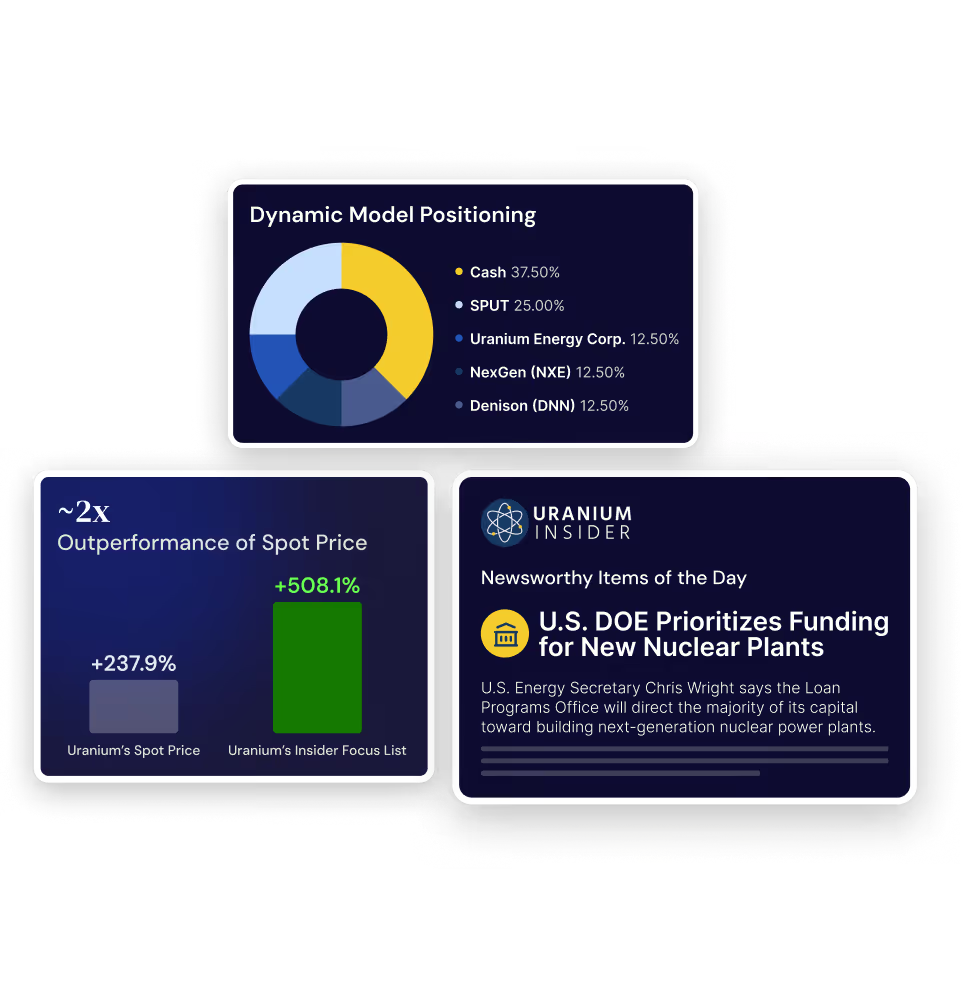
- Sentiment and Positioning: Huhn says sentiment now rivals March 2020, March 2023 and April 2025, periods followed by 100% to possibly 200% moves over 12 to 18 months. Uranium Insider built cash between December and April, began deploying in June, and describes its dynamic model portfolio as up over 50% since its February launch.